


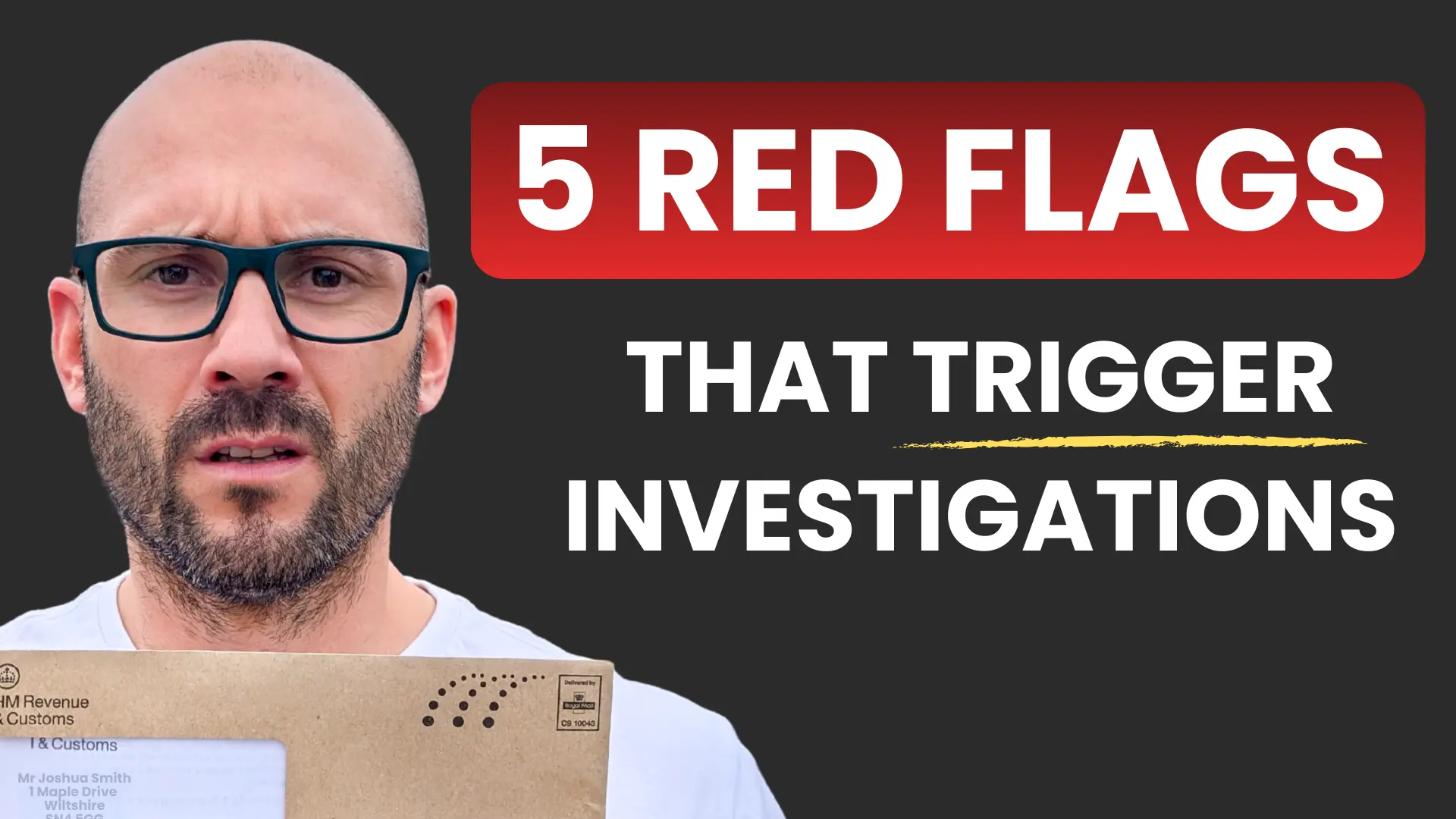
Imagine you receive a brown envelope from HMRC tomorrow morning.
The letter states simply: “We are checking your finances. Please explain these transactions.”
You have five minutes. Could you open your bank statements right now and explain every deposit, transfer, and cash withdrawal without guessing? If the answer is “no” then you are already on thin ice.
The reality of tax compliance is often misunderstood. Most HMRC enquiries don’t start because they suspect criminal activity. They start because a set of accounts looks confusing. To a tax inspector, confusing isn’t innocent. Confusing is interesting.
HMRC does not build cases on “vibes.” They build cases on mismatches. They compare what you say on your tax return against what your bank account says, and what third-party platforms report about you.
Your goal is to make your finances tell a boring, clean story. To help you self-assess your risk, we have identified the five biggest red flags that trigger HMRC checks.
Red Flag #1: Mixed Money and Unexplained Deposits
This is the fastest trigger for an enquiry. If you are the type of business owner who mixes personal and business finances in one “big soup” then you are inviting scrutiny.
HMRC sees your accounts differently than you do. You might see a friend paying you back for dinner, but HMRC sees an undeclared cash deposit.
The Discrepancy Trap Let’s say you declare £55,000 of income on your tax return, but your bank deposits show £78,000 landing across your accounts. You now have a £23,000 gap to explain.
If your explanation relies on memory such as “Oh, my partner sent me that” or “That was a refund” then HMRC will not accept it without evidence. If you cannot cleanly evidence a deposit, they will often treat it as taxable income.
The Fix: strict separation. Use a dedicated business bank account. Label every transfer clearly. Keep your statements so simple they read like a children’s book: Money in, money out, clear reason.
Key Takeaway
HMRC enquiries are rarely random. They are triggered by data mismatches specifically between your reported income and your lifestyle or bank deposits. Clean, separate records are your only defense against an intrusive investigation.
Red Flag #2: Lifestyle Doesn’t Match the Numbers
HMRC has access to vast amounts of data, often referred to as their “Connect” system. If your tax return declares a very modest income, but your digital footprint shows new luxury cars, expensive holidays, and home renovations, you have created a mismatch.
We aren’t moralizing your spending. We are looking at the paper trail. That extra money might be legitimate inheritance, savings, or a partner’s income. However, if you cannot document the source of those funds, HMRC will assume the simplest explanation: undeclared income.
The Fix: If you are funding your lifestyle with non-taxable money like savings or gifts, keep a paper trail in a dedicated folder. Never rely on “I’ll explain it later.”
Red Flag #3: Expenses That Fail the “Smell Test”
Expenses are the easiest place for business owners to accidentally look like risk-takers. HMRC reviews expenses not just for receipts, but for proportionality. Does this expense make sense for your specific trade and industry?
If you would be embarrassed to read an expense item out loud to an HMRC officer, do not claim it.
Common triggers include:
- Claiming personal meals as client entertainment.
- Claiming 100% of a personal phone bill.
- Mileage claims that suggest you drove to the moon and back.
- “Marketing trips” that look suspiciously like family holidays.
- Home office claims that amount to half your mortgage.
The Fix: Apply the “Smell Test.” If it looks aggressive, you need aggressive evidence to back it up. If there is no receipt or clear business justification, do not claim it.
Red Flag #4: The “Side Hustle” Platform Trap
With the rise of Vinted, eBay, Airbnb, and Etsy, HMRC is cracking down on platform income. The danger here isn’t necessarily the income itself, but the panic it causes during an enquiry.
There is one sentence that turns a small check into a full-blown investigation. When HMRC calls to ask about extra income, many people panic and say:
“Yeah, I do a bit of selling, but it’s not really a business.”
That sentence is petrol on the fire. It invites subjective questions. How much is “a bit”? How often? Did you buy with the intent to sell?
If you cannot split your personal clear-outs from your for-profit reselling cleanly, HMRC may treat the entire activity as a taxable trade.
The Fix: Keep records of personal items sold vs. stock bought for resale. If the income is regular, treat it like a business. Never “freestyle” a phone call with HMRC regarding side income.
Red Flag #5: Messy Patterns and Inconsistency
HMRC loves patterns. They hate broken patterns.
Administrative chaos is often interpreted as a lack of control, which implies tax errors. Things that quietly ramp up your risk score include:
- Repeatedly filing late.
- Frequent amendments to submitted returns.
- Wild swings in profit margins year-on-year without explanation.
- VAT figures that don’t align with turnover.
With Making Tax Digital (MTD) on the horizon, quarterly accuracy is becoming mandatory. Late or messy filings suggest you aren’t running a tight ship, making you a prime target for a check.
The Fix: Move to quarterly bookkeeping. Don’t wait until the end of the year to panic over a shoebox of receipts.
The Risk Scorecard: Where Do You Sit?
Review the five flags above honestly.
- Do you mix business and personal funds?
- Does your spending outpace your declared profit?
- Are your expenses aggressively high?
- Do you have undocumented side income?
- Are your filings often late or amended?
The Verdict:
- 0 to 1 Flags: Your records are likely “boring” and in the eyes of HMRC, boring is safe.
- 2 to 3 Flags: You should tidy up your accounts immediately.
- 4+ Flags: You are currently exposed.
Summary
If HMRC comes knocking, the winners aren’t the people with the cleverest accountants or the most complex schemes. The winners are the cleanest and the clearest.
Your goal isn’t to look innocent. Your goal is to be boring. Boring doesn’t get investigated.
If you are concerned about your current exposure or have received a letter from HMRC, do not panic but do not ignore it. Contact our team today to review your position.
Speak to a Tax Investigation Specialist
If you scored 4+ on the risk scorecard, you are exposed. Book a free confidential consultation to review your records before HMRC does.


